A thoughtful garden wedding aisle layout Singapore couples can adapt to their own venue does more than create a beautiful photograph: it guides guests, keeps the ceremony easy to follow and helps the couple feel present rather than preoccupied with logistics. In a garden, the aisle is part of a living setting, so the layout needs to work with paths, planting, light and the people moving through the space.
This guide focuses on the ceremony footprint—the approach, aisle, seating and ceremony focal point—not on choosing a venue or selecting décor. Whether you are planning a simple solemnisation or a larger wedding ceremony, start with the guest experience and build a clear plan that your venue team can review. Under Der Linden describes its Wessex Estate venue as a black-and-white colonial house with garden and indoor areas for weddings and solemnisations; couples can review the venue information and contact the events team to discuss their own event requirements.
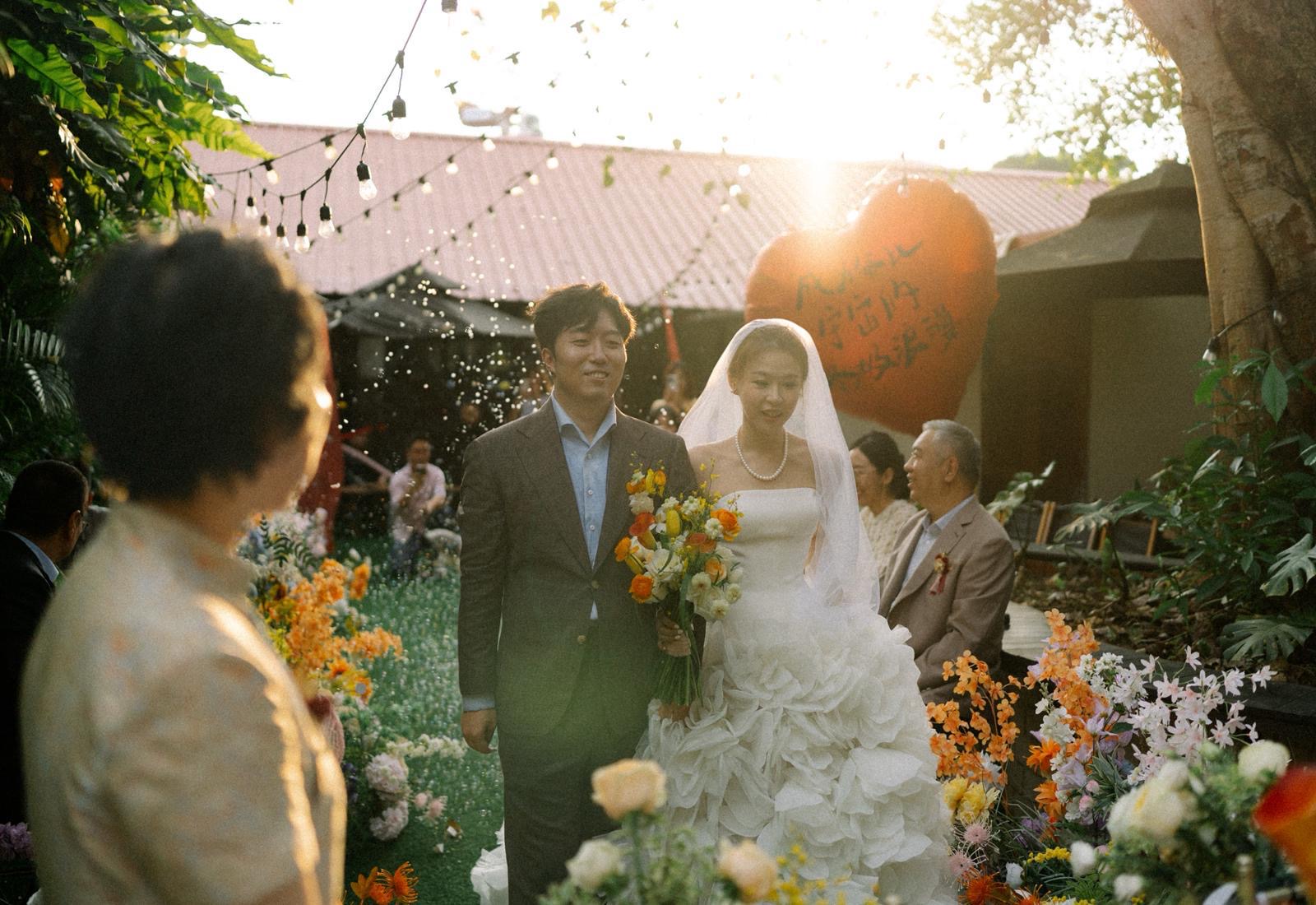
Garden wedding aisle layout Singapore: what makes the plan work?
A good layout answers four practical questions before anyone arrives: Where do guests enter? Where do they sit? How does the wedding party reach the ceremony area? And where will everyone go immediately after the vows? If those routes are easy to understand, the celebration feels composed even when the garden itself is informal.
Think of the ceremony area as three connected zones:
- Arrival zone: the point where guests approach, pause and find their seats.
- Ceremony zone: the aisle, seating and focal point where the couple and officiant stand.
- Transition zone: the route guests take after the ceremony, whether they are moving to refreshments, photographs or another part of the event.
Use a simple sketch to show these zones, then walk the route as if you were a guest who has never visited the site. If you have to guess where to turn, your guests may have to guess too. For the broader question of selecting an appropriate outdoor setting, see this garden wedding guide for Singapore couples; this article narrows the focus to arranging the ceremony itself.
A garden wedding aisle layout Singapore guests can navigate easily is one that feels intuitive before the ceremony begins: clear arrival, a visible seating area and a route that does not require guests to cross the processional.
How should you plan a garden wedding aisle layout in Singapore?
Begin with a measured site plan supplied or approved by the venue, not with an inspiration photograph. A picture can suggest a mood, but it cannot tell you whether the actual ground is level, which routes must stay clear or where guests can gather without blocking another activity. Ask the venue contact to identify the usable ceremony area, fixed features, access points and any boundaries that should not be crossed.
- Mark the fixed points. Note doors, steps, trees, planted beds, drains, columns, paths, power sources and any other features that cannot be moved. Confirm dimensions rather than estimating from a phone photograph.
- Draw the guest arrival route. Show where guests enter the space and how they reach their seats. Keep the route intuitive; avoid making people walk through the processional path to find a chair.
- Set the ceremony focal point. Choose a position where the couple can be seen from the planned seats and where the wedding party can stand comfortably without crowding the route.
- Test the processional path. Trace the route from the waiting point to the front, including the turn at the start and the stopping point at the end.
- Plan the exit and reset. Decide where the couple and guests move after the ceremony. Avoid a layout that forces the whole group back through a narrow entrance or across the next activity.
- Check the plan with the venue. Share the diagram early and ask what needs adjusting for access, safety, operations or the specific surface.
For an example of the different considerations that can arise when an event is held in a public park, read our guide to checking garden wedding permissions and venue rules. Private venues and public gardens may have different arrangements, so verify details directly with the relevant site rather than assuming one set of rules applies everywhere.
How wide should the aisle be?
There is no single aisle width that suits every ceremony. The appropriate clearance depends on the ground, how many people will walk together, whether anyone uses a mobility aid, what the venue requires and whether the route also serves another purpose. Instead of copying a measurement from an online diagram, ask your venue contact for the clear width they need and confirm that the layout meets it.
Draw the usable width—not just the distance between chair legs. Chair backs, decorative arrangements, bags and standing guests can narrow a route. If the aisle curves, check its narrowest point as well as the width at the entrance and front. Keep the route free of loose cables, raised edges and objects that guests might not notice.
Consider the processional itself. Will one person walk at a time? Will two people walk side by side? Will someone accompany the couple? Walk the route at the pace you expect, wearing the shoes planned for the day, and check that there is room to turn, pause and join the ceremony without squeezing past seated guests.
Which seating arrangement suits a garden ceremony?
Rows on both sides of a central aisle are familiar and easy to read, but they are not the only option. A shallow arc can help guests feel closer to the ceremony, while two short seating blocks can create a wider central route. The best choice is the one that gives guests a clear view while preserving a comfortable path and leaving space for the wedding party.
- Traditional rows: straightforward to explain and simple to number or reserve.
- Shallow semicircle: brings the outer seats around the focal point; check that the ends do not wrap behind the couple or obstruct circulation.
- Shorter blocks: can make an informal ceremony feel close and personal, but confirm that each block has a clear access route.
- Mixed seating: can work for a relaxed event, provided chairs remain stable on the surface and accessible spaces are planned intentionally.
Whichever arrangement you choose, avoid placing the furthest seats so far back that guests feel disconnected. Check sightlines from the seated eye level, not only from the standing position of the planner. If there are children, older guests or guests with mobility needs, ask them or their caregivers what placement would be most comfortable instead of making assumptions.
Seating is one part of the overall guest experience. Our garden wedding guest-comfort checklist covers other practical considerations for an outdoor celebration, while this guide stays focused on circulation and the ceremony layout.
For a garden wedding aisle layout Singapore couples can actually use on the day, treat the seating diagram as a movement plan too: show where guests enter, where they wait and where they go when the ceremony ends.

How do you protect sightlines and sound?
Before finalising the layout, ask a friend to sit in the seats most likely to have an obstructed view: the back row, the outer edges and any seat behind a tree, post or arrangement. Check that the couple’s faces and the officiant are visible. If photographs or video are important, identify the photographer’s working position early; a camera operator should not need to stand in the main guest route.
Outdoor sound also deserves a rehearsal. Gardens can feel quiet during a private site visit and quite different once guests are talking. Discuss microphone and speaker placement with the venue and sound supplier, if applicable, and keep equipment out of the aisle and accessible routes. Test spoken words from the furthest seats before guests arrive. Do not assume that projecting your voice will be enough, especially if there is traffic, wind, rain or activity nearby.
Lighting can affect both comfort and photographs. Visit the space at a time close to the ceremony hour if possible, and notice where the sun falls. The layout should not force the couple or guests to stare into strong light. A photographer can advise on positioning, but the ceremony should remain comfortable to experience in person, not just attractive in a frame.
What should you consider about Singapore weather?
Singapore’s tropical conditions make a practical backup plan worthwhile for any outdoor ceremony. Monitor the forecast in the days before and on the event day using the Meteorological Service Singapore website, then agree in advance who makes the call if conditions change. A backup is most useful when it is specific: which alternate space will be used, who communicates the change, how guests are directed there and how long the move will take.
A Plan B should be a real layout, not a vague promise to “move indoors if needed.” Draw the indoor arrangement too, including the aisle, seating, focal point, sound position and route between spaces. Confirm whether the same ceremony elements can be moved and who is responsible for doing so. If the venue has both indoor and garden areas, ask the events team how you should evaluate the options for your own date and event; Under Der Linden’s weddings and events page describes both indoor and garden spaces at its Wessex Estate venue.
Keep the backup communication simple. For example, decide who will tell the wedding party, who updates guests who have already arrived, and whether a sign or message is needed at the original entrance. This avoids relying on the couple to manage logistics moments before the ceremony.
How can the aisle feel personal without becoming cluttered?
Start with the garden, then add only details that help define the route or the focal point. A narrow aisle can feel crowded if every few steps contain a stand, lantern or floral arrangement. Keep decorative pieces outside the clear walking line and check that they remain stable if the ground is uneven or the weather changes.
Choose one or two visual cues to make the aisle legible: a simple marker at the entrance, a consistent line of chair decorations or a focal arrangement at the front. Repetition often looks more intentional than many unrelated objects. If you are planning a broader visual concept, our garden and heritage wedding décor ideas can help with the aesthetic; then test each proposed item against your actual floor plan.
A personal touch need not be elaborate. You might use a meaningful song, a family reading or a brief welcome that makes guests feel included. Build those moments into the ceremony sequence and make sure the people involved know where to stand and when to move. If the layout changes between outdoor and indoor plans, include those details in both versions.
What should go on your ceremony layout checklist?
Before you share the final plan with vendors, walk through this checklist with your venue contact:
- Is the ceremony footprint measured and approved for the specific space?
- Can guests identify the entrance and find their seats without crossing the processional?
- Is the full aisle route clear, including the narrowest point and every turn?
- Can the couple, officiant and wedding party stand and move without blocking a path?
- Can seated guests see and hear the ceremony?
- Are access routes, reserved seating and other guest needs considered?
- Are décor, sound equipment and photography positions outside circulation routes?
- Is there a drawn alternative layout for a weather change?
- Who decides whether the plan changes, and who tells guests?
- Does the post-ceremony route work without crossing another activity?
It can help to coordinate the ceremony footprint with the overall day schedule. See our Singapore wedding-day schedule guide for a practical way to think about transitions between key moments. If you are comparing garden and indoor settings, our guide to wedding venues with garden and indoor options covers the broader venue decision rather than the aisle plan.
Revisit the garden wedding aisle layout Singapore plan after the guest list, ceremony sequence and chosen space are confirmed. A small adjustment to the arrival point or seating blocks can make a bigger difference to flow than adding another decorative detail.
How does Under Der Linden fit into a garden ceremony plan?
Under Der Linden is in Wessex Estate, in a black-and-white colonial house setting. Its live Weddings & Events page describes weddings and solemnisations in a heritage setting with indoor and garden areas. Those are the venue facts couples can use as a starting point—not a substitute for checking the exact space and arrangements that suit a particular event.
When discussing your plan, bring your draft diagram, intended ceremony sequence and list of practical questions. Ask the events team which areas are available for your proposed arrangement, what routes must remain clear and how a weather alternative should be considered. Do not assume a photograph or an online description answers those event-specific questions. Visit the Under Der Linden Weddings & Events page to learn more and make an enquiry. The venue’s location page provides Wessex Estate and travel context for your planning.
For couples still comparing the type of setting they want, our guides to an outdoor garden solemnisation and an outdoor wedding venue in Singapore explore the venue decision. For an intimate celebration or a small wedding venue, consider how the layout supports conversation and clear movement, not just how many seats fit in a photograph. Couples can also explore our overview of an intimate wedding venue and a small wedding venue. These are separate considerations from confirming your ceremony plan directly with the venue.
Frequently asked questions about garden wedding aisle layouts
Is a straight aisle always best for a garden wedding?
No. A straight aisle is familiar and easy to follow, but the best route depends on the site, fixed features and the ceremony sequence. A slight curve or a different seating arrangement may suit a particular garden better. Confirm the layout and clear walking route with the venue before making décor decisions.
Should we plan the ceremony indoors as well as outdoors?
If your event includes an outdoor ceremony, ask the venue what alternatives are available and plan a second layout in advance. Specify who makes a weather-related decision and how guests will be informed. A practical backup should cover seating, sound, the processional and the route after the ceremony.
How do we make sure every guest can see the ceremony?
Check sightlines from the seats at the back and edges, and ask a person of average seated height to test them. Keep focal arrangements low enough not to block faces, and discuss any accessibility or reserved-seating needs with the venue and your guests.
When should we finalise the aisle layout?
Start early enough to receive venue feedback and coordinate with the people responsible for seating, décor, sound and photography. Reconfirm the plan after any change to the guest list or chosen space, and walk the final route during setup if possible.
What should we ask Under Der Linden about a garden ceremony?
Ask the events team to review the proposed ceremony area, guest route, indoor alternative and event-specific arrangements. The venue’s Weddings & Events page is the place to begin an enquiry. Share a simple sketch so the team can respond to the exact layout you have in mind.
🌿 Explore Our Wedding Venues
ð¿ Explore Our Wedding Venues
- â Intimate Wedding Venue Singapore
- â Garden Solemnisation Venue Singapore
- â Small Wedding Venue Singapore
- â Outdoor Wedding Venue Singapore
- â ROM Venue Singapore
- â Weddings & Events at Under Der Linden
ð Related Articles
- â Micro Wedding Singapore: How to Plan a Celebration Under 30 Guests
- â Garden Wedding Guest Comfort Singapore: A Practical Checklist for Couples
- â Best Intimate Wedding Venues Near Buona Vista & Dover MRT (2026 Guide)
- â Affordable Intimate Wedding Venues in Singapore: A Practical Planning Guide